
Blogs & News
Accelerating Secure Federated Learning with Aridhia DRE and Flower
Deploying production-ready federated networks in days, not months
The promise of federated learning (training machine learning models across distributed datasets without centralising sensitive data) is often constrained by infrastructure complexity particularly in life sciences and bioinformatics. Research consortia, healthcare networks, and pharmaceutical collaborations often spend months agreeing on an approach and then provisioning infrastructure before running their first federated experiment. Aridhia’s Digital Research Environment (DRE), combined with Flower’s federated learning framework, changes this significantly.
The Infrastructure Challenge
Establishing a federated learning network typically requires:
- Identifying and then provisioning secure compute environments at each participating site
- Configuring network isolation and VPN connectivity
- Deploying and maintaining federated learning orchestration software
- Implementing authentication and access control across organisations
- Managing governance workflows for data access request
Each of these steps introduces delay and a multi-site research collaboration might wait six months or more before infrastructure is agreed, ready and signed off. By that point, funding cycles have advanced, personnel have moved on, and the research question may have evolved.
Aridhia DRE: Out-of-the-Box Federation Infrastructure
The Aridhia DRE provides the base level infrastructure that makes rapid federated learning deployment possible. As an enterprise-scale Trusted Research Environment (TRE), the platform delivers:
Multi-Organisation Architecture
A single Aridhia DRE hub can host multiple organisations, each operating within a secure, isolated slice of the infrastructure. Individuals only access resources within their approved organisation. There is no cross-organisation data visibility without explicit governance approval.
Network Secure Workspaces
Workspaces can be restricted to be only accessible from within the enterprise VPN, providing SSO, MFA and defence-in-depth security. Researchers connect through their organisation’s VPN, authenticate to the DRE, and access their workspace in a controlled, auditable environment.
ISO 27001/27701 Certification
The Aridhia DRE maintains security and privacy certifications that meet the requirements of healthcare, life sciences, and regulated industries.
Flower: The Industry Standard for Federated AI
Flower has emerged as the leading open-source framework for federated learning, with adoption across Harvard, MIT, Cambridge, NHS, J.P. Morgan, and Mozilla. The framework’s architecture separates long-running infrastructure components from short-lived application code:
SuperNode: A long-running process deployed at each data site. The SuperNode connects to the central orchestrator, receives training tasks, executes them against local data, and returns results without exposing the underlying dataset.
SuperLink: The central orchestration component that coordinates federated learning runs. The SuperLink forwards task instructions to SuperNodes, collects results, and manages the aggregation process.
SuperGrid Flower’s enterprise platform for managing federations at scale. SuperGrid simplifies the creation and administration of federated networks, handling SuperNode registration, user authentication, and run management.
The framework supports PyTorch, TensorFlow, JAX, scikit-learn, Hugging Face Transformers, and other ML libraries. Researchers can federate existing training code with minimal modifications.
Architecture: Flower on Aridhia DRE
The integration deploys Flower components within the Aridhia DRE infrastructure:
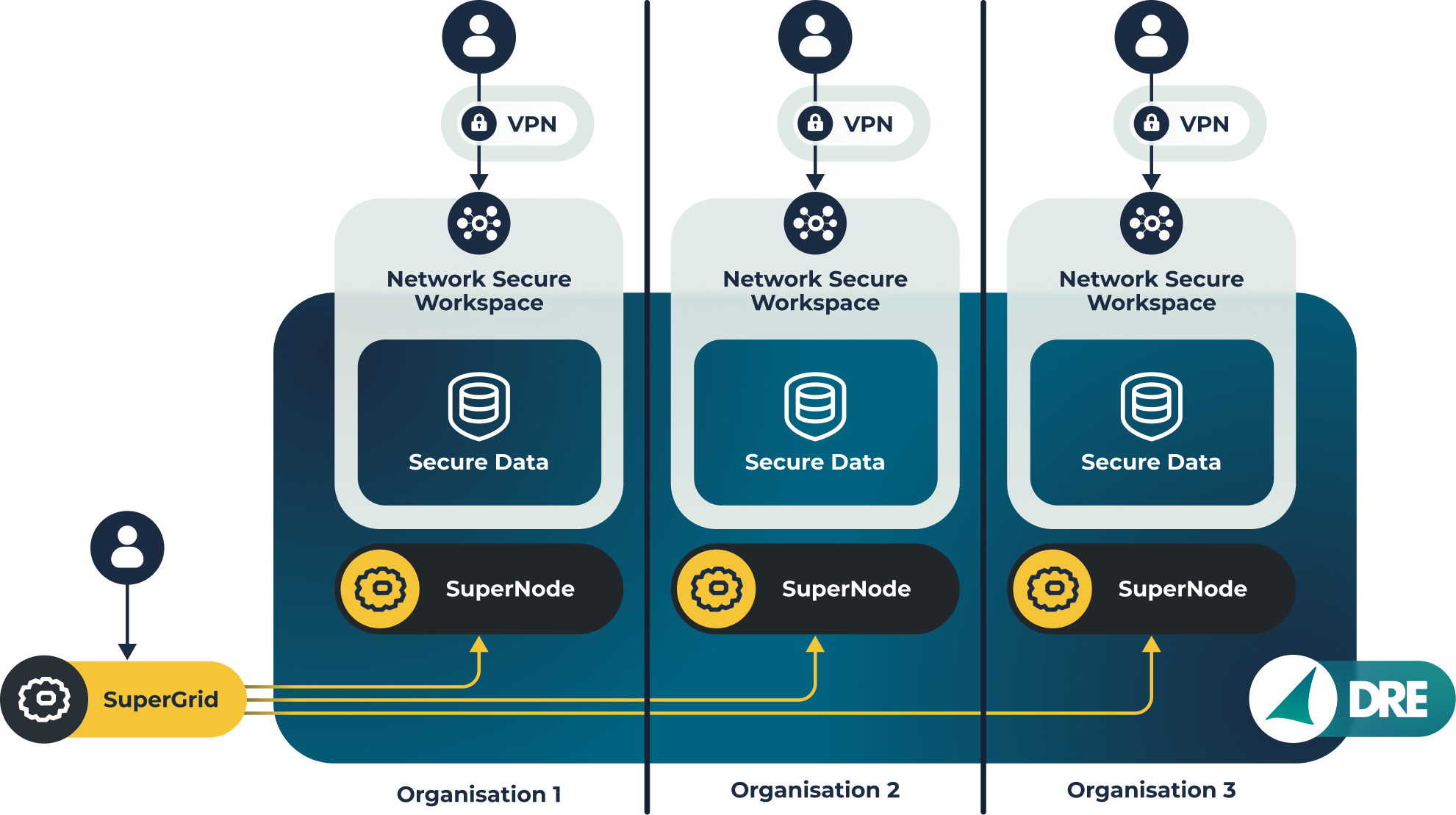
Each participating organisation receives:
- Dedicated Organisation Space: Isolated infrastructure slice within the DRE hub, preventing access from unapproved individuals or other organisations.
- Network Secure Workspace VPN-protected compute environment where researchers access data and initiate federated tasks. Administration of the node and participation in the learning network can be controlled from a workspace terminal or dedicated workspace virtual machine.
- Secure Data Storage: Organisation-specific data repositories that never leave the secure perimeter.
- Flower SuperNode: Accessible from the workspace terminal or virtual machine, ready to participate in federated learning runs.
Orchestration can be configured in two modes:
- Flower SuperGrid: External orchestration using Flower’s managed platform for
federations that span multiple independent deployments. - Internal SuperLink: A SuperLink deployed within the Aridhia DRE hub, administered from a dedicated orchestration workspace with cross-organisation access for reviewing run outputs.
Use Cases and Value Proposition
Multi-Site Clinical Research
A consortium of five hospitals wants to train a diagnostic model on medical imaging data. Under traditional approaches, each hospital would need to negotiate data sharing agreements, anonymise and transfer data to a central location, and navigate months of governance review.
With Aridhia DRE and Flower, each hospital provisions a secure organisation within the DRE hub. Imaging data remains on-site. Researchers submit federated training runs that execute locally at each site, returning only model gradients (not patient data) to the aggregator. The consortium trains on a combined dataset of 50,000 images while maintaining compliance with GDPR and institutional data governance policies.
Pharmaceutical Collaboration
Three pharmaceutical companies want to jointly train a drug-target interaction model using proprietary compound libraries. No company will share their molecular data with competitors.
Each company operates within an isolated Aridhia DRE organisation. Flower SuperNodes execute local training against proprietary datasets. The federated model benefits from the combined chemical diversity of all three libraries, while each company’s intellectual property remains protected within their secure perimeter.
National Health Data Networks
A national health authority wants to enable research across regional health boards without centralising patient records. The Aridhia DRE hosts organisations for each health board, with Flower SuperNodes enabling federated analytics and model training across the distributed network.
Researchers in a central orchestration workspace can initiate federated queries and review aggregate results without accessing record-level data at any participating site.
EHDS-Compliant Federation
For European Health Data Space (EHDS) compliance, the Aridhia DRE supports both Level 1 and Level 2 federation. Use-case data can be provisioned in a Secure Processing Environment (SPE) within the DRE cluster, with federated access managed through an integrated Federated Node. The configurable DAR process supports the EHDS data application form, ensuring regulatory compliance.
Deployment Timeline
The combination of Aridhia’s pre-built infrastructure and Flower’s standardised components compresses deployment from months to days:
Traditional Approach

Total: ~8 months to first federated run
Aridhia DRE + Flower

Security certification: Pre-certified (ISO 27001/27701)
Total: ~1 week to first federated run
Getting Started
Aridhia has demonstrated the capability to deliver Flower‑enabled federated learning networks as an out‑of‑the‑box feature of the DRE platform. This includes:
- Provisioning a multi‑organisation DRE hub
- Configuring Flower SuperNodes for participating sites
- Establishing governance workflows for federated data access
- Integrating with existing research data management systems
Organisations interested in deploying federated learning infrastructure can contact us to find out more.
References
- Aridhia DRE Platform: https://www.aridhia.com/our-platform/
- Aridhia Data Federation: https://www.aridhia.com/data-federation/
- Flower Framework Documentation: https://flower.ai/docs/framework/
- Flower Architecture: https://flower.ai/docs/framework/explanation-flower-architecture.html