Janssen R&D and Gates Ventures initiate partnership to analyze existing biosamples during COVID-19 clinical trial shutdowns.
How the Aridhia DRE provided the secure, federated infrastructure for the Global Neurodegeneration Proteomics Consortium to harmonize ~250 million protein measurements across 23 international cohorts.
Neurodegenerative diseases affect more than 57 million people worldwide, with prevalence expected to double every 20 years. Despite this growing burden, treatment options remain limited due to disease heterogeneity, prolonged preclinical phases, and diagnostic challenges.
High-dimensional proteomic studies offer promise for scalable biomarker discovery, but the siloing of data across fragmented research communities has historically hindered progress. Large, harmonized datasets are essential for robust omics research in heterogeneous clinical populations.
Sensitive patient-derived proteomic and clinical data required handling under GDPR, HIPAA, and institution-specific data governance policies across multiple countries.
Proteomic data from SomaScan 5K/7K, Olink, and mass spectrometry platforms required harmonization across variable clinical metadata, diagnosis criteria, and sample types.
Over 100 active researchers from 23 institutions needed simultaneous access to shared datasets while maintaining data provenance and reproducibility standards.
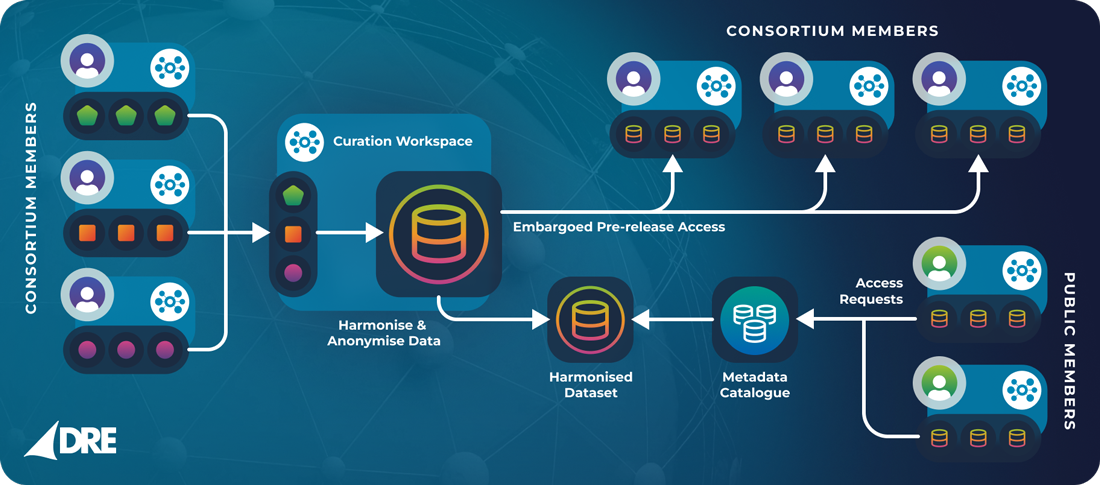
Rather than centralizing sensitive data in a single repository — legally and logistically unworkable across 23 international partners — the GNPC adopted a federated model using the Aridhia DRE as a secure network of cloud-based Workspaces, enabling modular collaboration while maintaining full data governance.
Each cohort gets a private workspace, acting as a secure digital silo. Data owners upload, clean and document their raw proteomic and clinical data. Nothing moves outside without their approval.
Dedicated workspaces for data engineering teams. Using R, Python, SQL and Jupyter, curators standardise variables, map clinical metadata and perform QC across all cohorts with full lineage tracking.
Curated analysis-ready data is published to a searchable catalogue, making harmonised V1 data easily findable. Rules for access are clearly defined and governed with built-in data access workflows.
Approved researchers access harmonised data in workspaces fully equipped for statistical and machine learning workflows. All work happens in situ, and results leave only through audit-gated export.
The Aridhia DRE allowed us to turn a global network of proteomics data into a living, collaborative research platform. Without it, harmonizing sensitive datasets across jurisdictions while maintaining security and compliance would have been nearly impossible.
Dr. Farhad Imam, GNPC Co-Lead
Using native DRE capabilities allows GNPC's multi-instititutional longitudinal data collection across different data modalities (clinical, cognitive, plasma, serum, and CSF data across three proteomics platforms). This enables curators to operate as a distributed team with real-time access to tools, documentation, and harmonized data.
Each Workspace was scoped to a specific stage of the data lifecycle, and raw data never crossed a jurisdictional boundary. With the platform’s high security standards and Workspaces designed for flexibility, curators and researchers alike are able to effectively and collaboratively do their work.
The result was a single, harmonised, analysis-ready dataset used by researchers worldwide.
The GNPC proves that international data science can be both collaborative and secure. By using DRE-powered Workspaces to build a network of controlled-access environments, the consortium was able to move fast, stay compliant, and unlock critical insights into neurodegenerative diseases
Dr. Niranjan Bose, AD Data Initiative Interim Executive Director
Private, airlocked cloud environments satisfying GDPR, HIPAA, and institutional data governance requirements across multiple jurisdictions.
R Development Environment, Python, Jupyter Notebooks, and SQL directly within secure workspaces for proteomic QC and harmonization workflows.
Native support for reproducible research with Git integration, enabling teams to trace each protein or clinical variable back to its source.
Cloud-based infrastructure with Western European data residency, enabling cross-border collaboration without moving sensitive data outside approved jurisdictions.
Configurable data access request workflows with multi-stakeholder approval chains, ensuring data usage aligns with consortium policies.
GPU-backed virtual machines and multi-cluster configurations supporting machine learning workflows on datasets with 250+ million measurements.
Janssen R&D and Gates Ventures initiate partnership to analyze existing biosamples during COVID-19 clinical trial shutdowns.
GNPC formally established with 23 contributing cohorts. Aridhia DRE deployed as the secure analysis infrastructure.
First version of harmonized dataset made available to consortium members for collaborative analysis within DRE workspaces.
HDS V1 released to global research community via AD Workbench, accompanied by four Nature Medicine publications.
5,000+ additional samples from Central/South America, Asia, and Africa to improve global representation.

The harmonized dataset has already fueled novel discoveries across multiple workstreams, demonstrating the power of large-scale collaborative proteomics.
Identification of 27+ robustly elevated proteins in AD plasma across multiple independent cohorts
256-protein clinical severity signature with r=0.58 correlation to CDR scores in held-out test set
Disease-specific patterns of accelerated aging across brain, liver, artery, and muscle systems
5-protein panel predicting APOE ε4 carrier status with AUC 0.90-0.96 across disease groups
The Aridhia DRE provides the secure, scalable infrastructure needed for large-scale collaborative biomedical research. Whether you're working with proteomics, genomics, imaging, or clinical data, our platform supports the full research lifecycle.