
Scans a source database and profiles its tables, fields, and value distributions, producing the groundwork needed to plan a mapping to the CDM.
Health data is recorded differently everywhere it's collected using different structures and terminologies. The OMOP Common Data Model addresses this this by giving health data a shared structure and a shared vocabulary, so the same analytical code can run against datasets held in different hospitals, countries, and systems.
This page explains what OMOP is, who maintains it, the tools built around it, and how the Aridhia DRE supports organisations through transformation, validation, and analysis.
The Observational Medical Outcomes Partnership (OMOP) Common Data Model (CDM) is an open community data standard that defines how observational health data should be structured. OMOP is a relational schema of thirty-nine standard tables, organised into six broad categories.
Every clinical event in the model is tied to a person and a date, this allows disease progression, treatment pathways, and outcomes to be studied consistently across harmonised datasets.
A central part of the OMOP CDM is its use of standardised vocabularies. Source data is typically recorded using local or national coding systems, hospital-specific codes, free text, or terminologies like ICD-10.
The OMOP CDM maps these source codes to a single set of standard concepts, most commonly drawn from SNOMED CT for clinical conditions, RxNorm for drugs, and LOINC for measurements. Each standard concept has a unique concept_id, and every clinical fact in the model is recorded against one of these standard concepts rather than the original source code.
Our DRE streamlines OMOP use today and plans a CDM framework to automate metadata, schemas, search and cross‑dataset cohorts for smoother research workflows.
Discover how the Aridhia DRE supports OMOP adoption, from data harmonisation and validation in FAIR to cohort analysis tools in secure Workspaces.
OMOP CDM in the Aridhia DRE: ETL pipelines, FAIR Data Services, OHDSI Atlas, CohortMethod, and PatientLevelPrediction for secure observational health research.
Aridhia introduces community apps for the DRE. Open source, containerised tools including SQL Workbench, OMOP Cohort Builder, and AIRAlock.

Observational Health Data Sciences and Informatics (OHDSI), pronounced “Odyssey,” is an open-science, multi-stakeholder collaborative that grew out of the original OMOP project when it concluded in 2013. Founded in 2014 and coordinated through Columbia University, OHDSI is a worldwide community that brings together researchers from academia, industry, and government to maintain the OMOP CDM, build and maintain tools for converting data to the OMOP CDM, develop open-source analytical tools for the CDM, and run large-scale network studies across a shared international network.
Unlike a conventional standards body, OHDSI operates as an open, volunteer-driven community. It spans hundreds of institutions across more than 30 countries, including academic medical centres, pharmaceutical companies, regulators, and government health agencies, all working from the same open-source codebase and the same shared vocabulary. This breadth is part of what gives OMOP its practical value: the model isn't maintained by a single vendor with commercial incentives, but by the same global community of researchers and institutions who rely on it day to day.
Common data models are not a new idea, but OMOP adoption appears to be reaching a critical mass across the health data sector. In the UK, the NHS Secure Data Environment (SDE) Network has agreed to adopt OMOP as its common data model, and the European Health Data and Evidence Network (EHDEN) funds and supports OMOP transformation projects across European health institutions.
Much of this is driven by the same forces reshaping the wider TRE landscape, particularly the increasing adoption of federated analytics and federated learning. These only work at scale when the datasets involved share a common structure. A shared standard like OMOP is effectively a prerequisite for a successful implementation.

In this episode of Trusted Research Conversations we are joined by Wouter Franke and Liam Glück of The Hyve to discuss data harmonisation, the OMOP Common Data Model, and OHDSI the community that maintains OMOP and its associated tooling.
Listen NowAridhia has supported the OMOP transformation journey for a number of DRE customers, including Great Ormond Street Hospital and the Sydney Children's Hospital Network. OMOP is currently the most frequently adopted common data model among Aridhia DRE data owners, and the DRE provides support across the full journey: transformation, metadata management, discovery, and analysis.
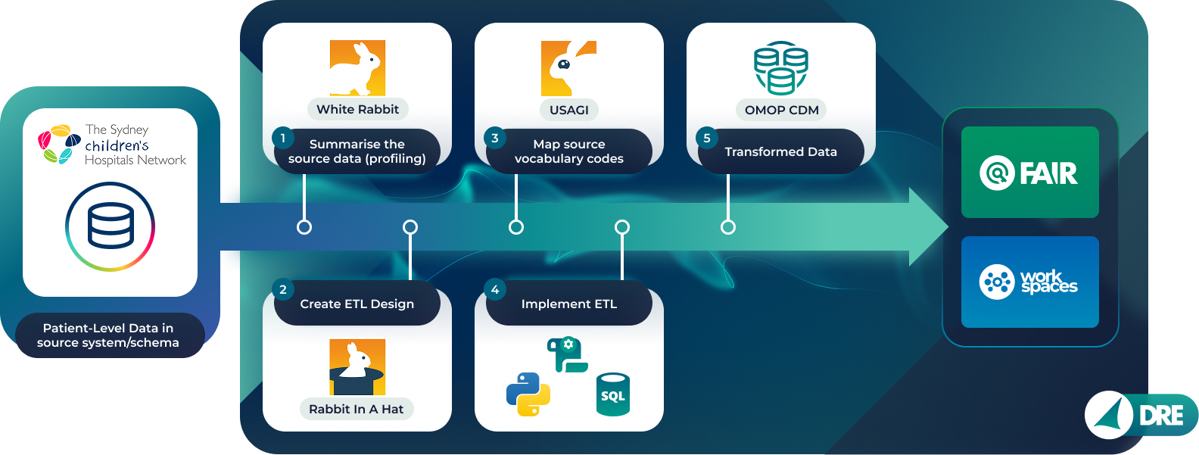
For data owners transforming source data into OMOP, the Aridhia DRE provides a secure, customisable environment for hosting the ETL pipeline.
Source data is de-identified and moved into the platform under controlled, VPN-based access, then processed using the OHDSI tooling (WhiteRabbit, Rabbit-In-a-Hat, and USAGI) to build and validate the mapping before loading the result into an OMOP database:
FAIR Data Services, Aridhia's metadata catalogue, includes a data models feature that lets data owners identify a dataset as using the OMOP CDM, and lets researchers search and filter datasets by the common data model.
Where a dataset is identified as OMOP, data owners can run it against a four-level validation report:
| Validation | Description |
| Basic | All OMOP CDM dictionaries are present; non-OMOP dictionaries may also exist in the dataset |
| Bronze | All OMOP CDM dictionaries are present with expected columns; non-OMOP dictionaries and columns may exist |
| Silver | All OMOP CDM dictionaries and columns are present, no additional dictionaries or columns allowed; column types are not checked |
| Gold | All OMOP CDM dictionaries and columns are present, no additional dictionaries or columns allowed, and column types must be correct |
The report is generated as a downloadable file for the data owner, giving a clear, gradable picture of how closely a given dataset conforms to the OMOP specification before it's made available to researchers.
Additionally, data owners with an existing OMOP dataset in FAIR can duplicate its common dictionaries when creating a new one, and FAIR's customisation features makes it simple to surface OMOP-specific resources, such as links to Athena.
For datasets imported directly into a workspace, an OMOP Validation tool compares the database tables against the expected metadata for the stated CDM version, flags discrepancies such as incorrect field types, and can optionally correct them.
For exploration and reporting, the workspace OMOP Browser connects directly to the workspace's database and gives researchers a dynamic, concept-aware browser for exploring tables and concept counts, assembling cohorts against standard OMOP domains, and visualising data.
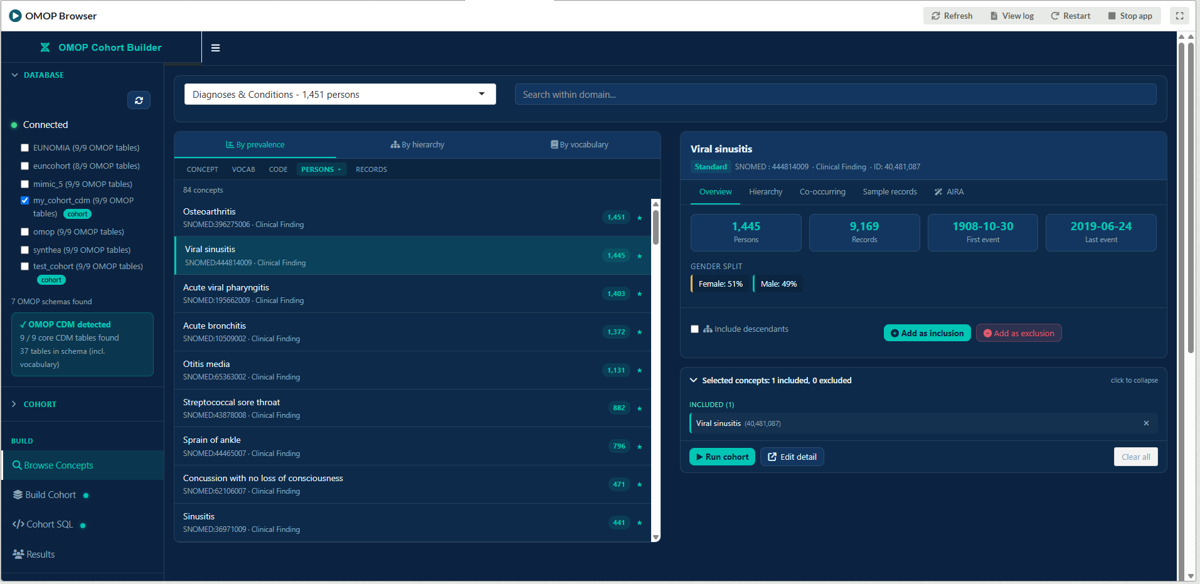
Results can be exported as database schemas, CSVs, or a dynamic R Markdown report that can be turned into a collaboratively edited Word document directly inside the workspace, alongside reusable R scripts for each analysis.