
FAIR Data Services and EHDS
This is the first blog a series detailing how the Aridhia DRE can be used to ensure Health Data Holders are ready to comply with the secondary use requirements of the European Health Data Space (EHDS) legislation when they come into force in March 2029. In this blog we explore how FAIR Data Services, Aridhia’s metadata catalogue, can be used to capture metadata in an EHDS compliant manner and make it available to a national level catalogue.
EHDS Article 60:
EHDS Article 60 sets out 5 duties that Health Data Holders have:
- Health data holders are required to make their electronic health data referred available upon request to the Health Data Access Body (HDAB).
- They are required to make the data available to their HDAB within three months of a request, though this may be extended to six months in some circumstances.
- They are required to provide their HDAB with up to date descriptions of their datasets, and verify these are correct at least annually.
- They can provide a data quality and utility label with their data, where this is the case the HDAB should be provided with documentation that will allow them to verify the accuracy of the label
- Holders of non-sensitive data are required to provide access to it through trusted open databases.
The EHDS legislation covering the secondary use of health data comes in to force in March 2029, and to fulfil the above duties data holders will need a robust system in place for cataloguing and managing their data holdings. We believe that FAIR Data Services can be an invaluable tool in helping data holders meet their obligations under EHDS.
FAIR for Health Data Holders:
The duties detailed above are essentially those of data management, the Health Data Holder has to be able to:
- Accurately reflect their data holdings and keep them updated.
- Be able to provision approved data in the agreed time frame.
- Provide assurances on data quality and utility.
FAIR Data Services already offers a number of features that allow our data owners to successfully discharge these functions.
Custom catalogues:
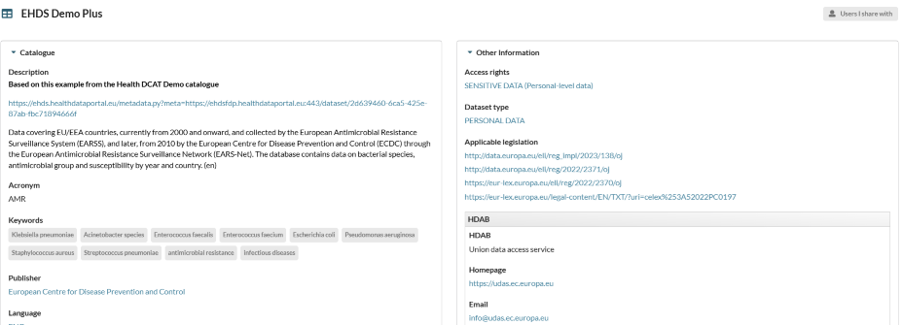
Our catalogue templates are fully customisable, allowing data owners to capture the dataset metadata they need. Using this flexibility we have already successfully trialled the creation of an EHDS Health DCAT-AP compliant catalogue template, and will make this generally available in our hubs after user validation.
Dataset Creation Wizard:
FAIR’s easy to use dataset creation wizard means that data holders can create new records in a few steps:
Data validation and data models:
FAIR provides data owners with a suite of tools for managing their data, including data validation reporting. The data validation report confirms that dataset dictionaries match the underlying data, including field names and types. The data owner is provided with a report on any mismatches, and if the data is hosted in FAIR they can run a conversion job to resolve them. FAIR data model validation allows the data owner to specify the data model their dataset adheres to, for example OMOP. In this case, FAIR can then run a validation report to confirm that the dataset conforms to the structure of the advertised data model. In addition to curated data models available in all FAIR hubs, users can create their own bespoke data model validations.
Role Based Access Control:
In a large organisation with complex data holdings catalogue management will not be a one person job. FAIR’s Role Based Access Control (RBAC), makes it easy to give users the access they need to perform their jobs. For example, our curated roles include:
- Administrator – manages the platform, grants access to users
- Data Manager – manages datasets, can edit and update metadata
- Data Steward – has the permissions of both the Administrator and Data Manager roles.
As with many other aspects of FAIR user roles are fully customisable. If the curated roles don’t have the combination of permissions that an organisation needs they can create their own custom role with appropriate permissions.
API integration:
FAIR has an open API which is documented here, this allows hub owners to integrate easily with upstream and downstream systems. A good example of this is our metadata syndication with the HDR Innovation Gateway which is detailed here. The next blog in our series will explore how Aridhia Workspaces align with the emerging EHDS Secure Processing Environment (SPE) specification. If you would like to know more about the Aridhia DRE please get in touch.