
EPND: Lessons for EHDS from the European Platform for Neurodegenerative Disease
This is the second blog in a two-part series where we reflect on Aridhia's involvement in the PHEMS and EPND projects over the past four years. Both projects are multi-national, EU-backed collaborations focused on improving access to research data, and both have had positive outcomes. Both are now coming to their conclusion.
In this second blog we look at EPND, its objectives and outcomes, and Aridhia's contribution to the project. We also reflect on the lessons from EPND which will be applicable to the European Health Data Space (EHDS).
What is EPND?
EPND is the European Platform for Neurodegenerative Disease. It is a consortium of academic and industry organisations brought together to create a technical hub that allows innovators and researchers from across the EU to discover and access high-value datasets on neurodegenerative diseases.
The project has successfully delivered this technical hub, and the focus for the final stages of the project has been establishing a legal entity which can continue to host and support the hub.
You can access the full EPND hub here.
What was Aridhia's contribution?
Aridhia's involvement in EPND was primarily driven by our partnership with the Alzheimer's Disease Data Initiative (ADDI). Aridhia and ADDI are both members of the EPND consortium, and the Aridhia DRE also provides the backbone of ADDI's Trusted Research Environment (TRE), the ADWorkbench (ADWB).
In the initial stages of the project we provided consultancy on how metadata from the ADWB catalogue could be syndicated to the EPND hub. Latterly we have worked on one of the project's key deliverables, the integration of the EPND technical hub with the ADWB DAR process. This allows researchers to submit a request from the EPND hub for a dataset held in ADWB, e.g. the AMYPAD or EPAD datasets.
Working with our partners in the consortium we have delivered a seamless experience where:
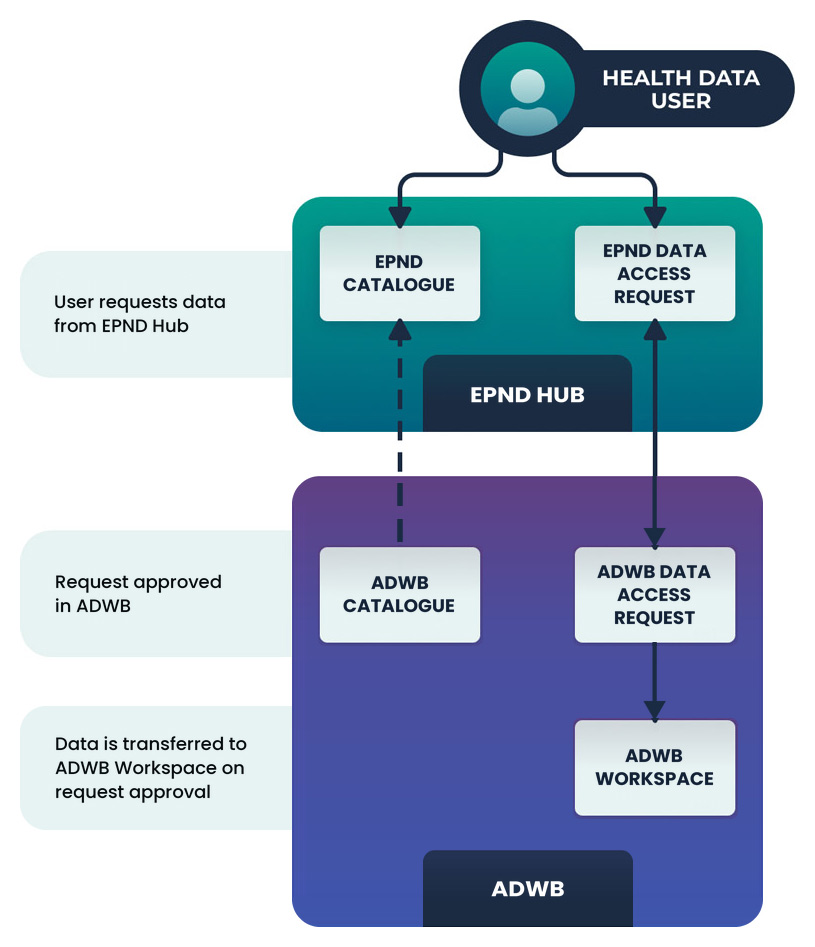
- ADWB metadata is discoverable in the EPND technical hub
- Users of the EPND hub can request access to an ADWB-hosted dataset
- This request is passed to the ADWB for approval
- When this request is approved in the ADWB the user is notified in the EPND hub
- The user can then transfer their data into an ADWB workspace for analysis
What were the project outcomes?
EPND has achieved a number of important outcomes:
- Creation of the EPND technical hub, and its metadata catalogue, allowing researchers to discover and request a large number of high-value neurodegenerative disease datasets
- Seamless integration of the EPND technical hub with the ADWB, allowing researchers to request access to data in EPND and analyse it in ADWB
- Establishment of a legal entity to continue to deliver this service beyond the end of the project
Lessons for the EHDS: the challenges of integration
The implementation of the EPND/ADWB integration closely mirrors the planned EHDS architecture, both between the EHDS central services and Health Data Access Bodies (HDABs), and between HDABs and Trusted Health Data Holders (THDH).
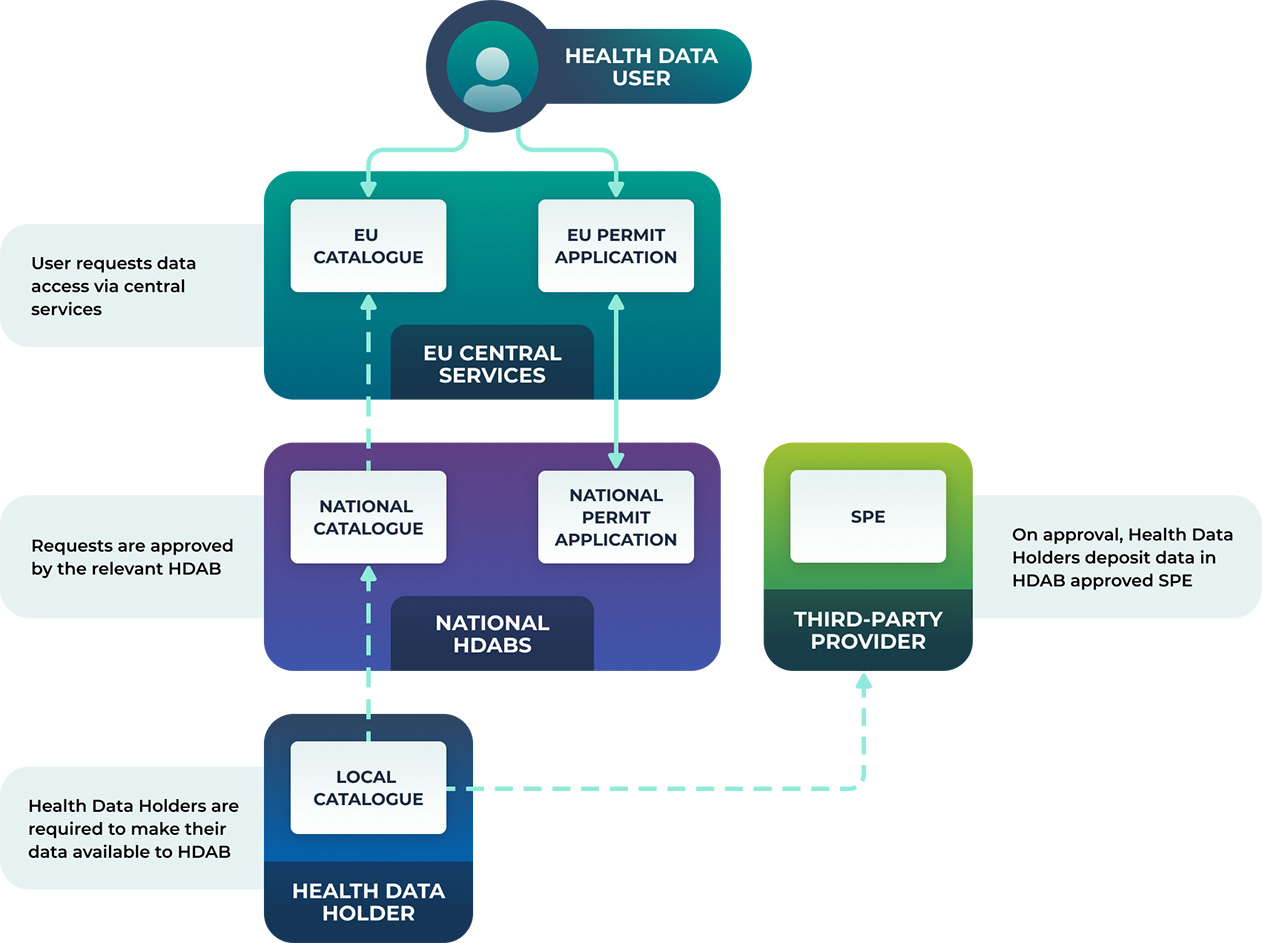
In both scenarios the subsidiary partner is expected to:
- Provide metadata to the higher-level catalogue
- Receive data permit requests from the higher level
- Review these requests and provide a decision (HDAB) or recommendation (THDH)
- Where the permit is approved, provision the requested data in a Secure Processing Environment (SPE), the EHDS equivalent of a TRE
The expected integration between EHDS central services and HDABs is documented in the TEHDAS2 project deliverables. However, these have very little to say about the relationship between HDABs and Trusted Health Data Holders.
The EPND/ADWB integration was carried out by dedicated software teams, working closely together. Even in this case it was not a straightforward task, as the teams had to map existing workflows and work across different tech-stacks. They also had to create comprehensive integration documentation for the end of the project to ensure the integration could be easily supported in future.
As noted above, at present there is little documentation on how data holders should integrate with their responsible HDAB. If EHDS is to scale successfully then HDABs will have to provide clear, up-to-date documentation on how to integrate with their national-level catalogues and permit processes. They will also need to be responsive to integrator queries and able to resolve any issues these users discover. As an additional complication, they will not have the clear one-to-one relationship that EPND/ADWB had, but relationships with multiple integrators using different software and at different levels of technical maturity.
These challenges are real, but not insurmountable, and at Aridhia we are ready to work with our European partners to ensure the transition to the EHDS is as easy as possible. If you'd like to know more about this please contact us here.