
PHEMS Project Update 2026 – What We’ve Done So Far
We last provided an update on the PHEMS project in mid-2025, after the annual conference. Work has continued since then, and this post provides an update on Aridhia’s work developing the Federated Node for PHEMS, helping establish a production ready federated network between the initial participant hospitals, and developing an audit and controls framework for future network operations.
The Federated Node
As detailed in previous blogs, our primary role in PHEMS has been developing the Federated Node (FN), an open source component for running federated data analysis. The FN itself was demoed at the second PHEMS consortium meeting in 2024, and at the 2025 meeting it was demoed operating as part of the MVP PHEMS network.
PHEMS has two high-level data federation use cases:
- Sharing clinical benchmarking data via the federated network, allowing the participating hospitals to compare outcomes on variety of treatments and procedures.
- Using the federated network to run ML models on rare disease data held by each partner. The initial objective is to create predictive models for sepsis and haemophilia.
Network testing and the subsequent demo at the 2025 meeting proved that the first of these use cases is now supported by the FN when deployed in the PHEMS network.
We are still developing the FN to support the second use case. Working with our partners in the consortium Erasmus MC, we have successfully tested a PoC where their haemophilia model was run on test data using an ML plug-in developed for the Federated Node. Our objective for the first quarter of 2026 is to demo an integrated version of this PoC at the PHEMS conference in March.
The PHEMS Network
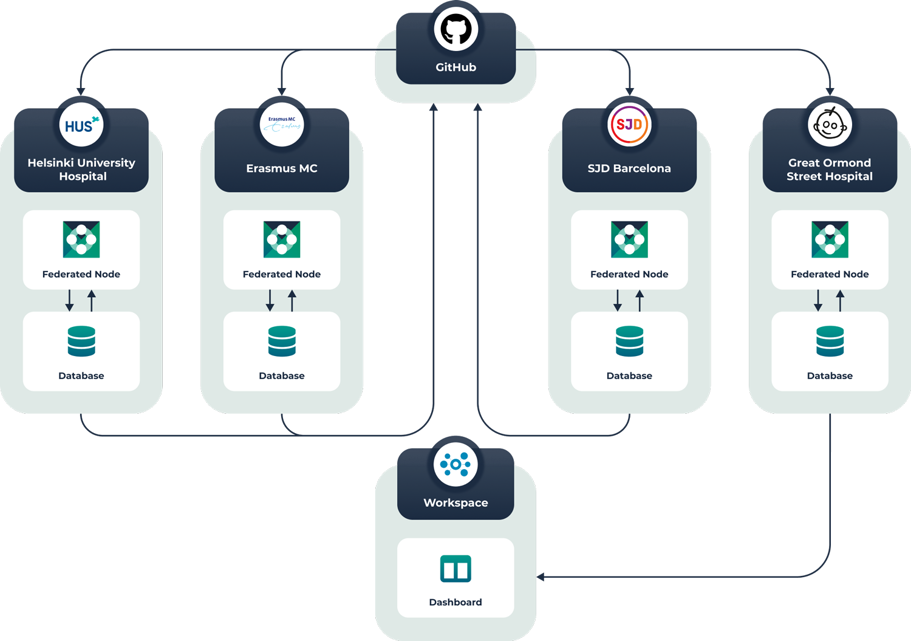
In parallel with FN development we are also helping the four founding partners of the PHEMS network to onboard. This is primarily in our role as the developer of the FN, which each partner must deploy, and connect to the shared GitHub project which is used to manage analytical code and initiate tasks. Additionally, Aridhia is also providing a workspace to collate and display the benchmarking results.
Figure 1 below provides an overview of the network, and the 2025 conference blog explains how it functions in more detail.
Audit and Controls:
Our third contribution as the project enters its final year is the development of an audit and controls framework to support the ongoing functioning of the network.
The primary objective of the PHEMS project is use the network established during the project to found the Paediatric Health Data Space, with the ultimate goal of onboarding all of the members of the European Children’s Hospital Organisation (ECHO), and supporting a wider number of clinical use cases. If the network is to successfully scale in this way it needs agreed policies for dealing with standard admin tasks like onboarding users, support and fault resolution processes, and procedures in place for serious issues like accidental data release. All of the above are features of an audit and controls frame.
The Aridhia infosec team will be working with our partners in PHEMS to ensure the minimal required version of this is in place by the end of the project.
We look forward to catching up with our consortium partners at the next meeting in Barcelona, and will provide a further update then. If you have any questions about our work on PHEMS or federation more generally please get in touch here.